

What does “DeepSearch AI” mean, and can it help with research? The phrase does not always refer to one specific tool. It may describe an AI-powered search feature, a product name, or a broader approach to finding and summarizing information with AI. So the term alone does not tell you what a particular service can do.
In general, AI-assisted search may help you explore a topic or bring information from multiple sources together. Its usefulness depends on how the tool works, what sources it can access, and how clearly it shows the basis for its answers. Check the specific product and its current details before drawing conclusions about its capabilities.
What DeepSearch AI means
AI deep search is a way of searching in which artificial intelligence may help find information across sources, bring related details together, and present a synthesized answer. The goal is often to respond to a research question, rather than simply return pages that match a set of keywords.
With conventional search, you typically enter terms and review links and snippets yourself. A general-purpose chat assistant, by contrast, may respond conversationally without necessarily searching current or external material. To understand how conversational AI tools work beyond research tasks, see our guide to AI Assistants: What They Can Do, How to Use Them, and What to Watch For. An AI deep search tool may combine elements of both: it can search for information and then summarize what it finds.
These are broad distinctions, not fixed rules. Some search engines include AI summaries, and some chat tools can access search results. The process, sources, and level of detail vary by service, so the label alone does not show what a particular tool does.

How an AI deep search typically works
AI deep search tools can use different processes, but a search may involve several broad steps. The exact workflow depends on the product and the sources it can access.
- Interpret the question by identifying its topic, key terms, and the information being sought. A focused question can help define the task.
- Look for potentially relevant material in sources available to the tool. The sources can differ from one service to another.
- Extract and compare details related to the question, bringing together points that appear similar or different across sources.
- Present a response, often as a summary. Some tools may refer to the material they used, but whether sources are shown and how much context is provided varies.
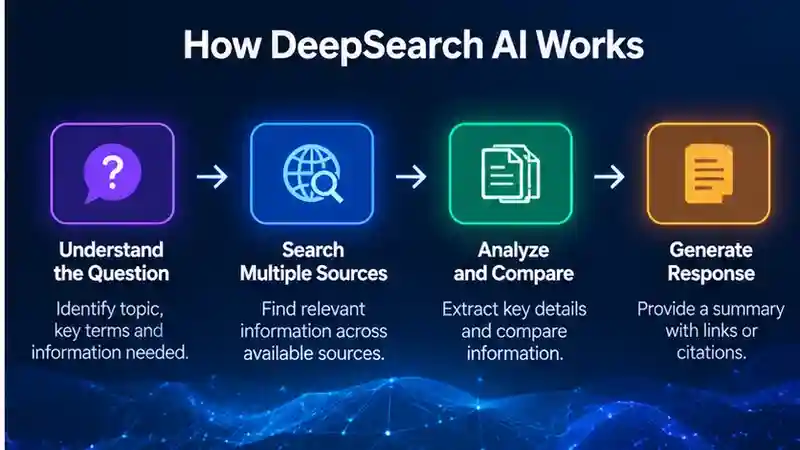
This is a general description, not a guaranteed sequence. A summary reflects selected material, so check important claims against the underlying sources when possible.
Read Also: AI Systems Explained: How They Work, Where They Help, and What to Watch For
AI Deep Search vs. Traditional Search
Traditional search typically matches your query to pages and presents links and snippets for you to review. AI deep search may draw on available sources and summarize or synthesize information into a response. The distinction is not always clear-cut, and neither label guarantees a particular process or level of detail.
| Aspect | AI Deep Search | Traditional Search |
|---|---|---|
| Search Process | May break a question into smaller queries and combine information from multiple sources. | Typically matches a query with relevant webpages and other indexed content. |
| Presentation of Results | Often provides a written summary with links or citations. | Usually lists links and snippets; modern engines may also offer AI-generated summaries, so these categories can overlap. |
| Source Transparency | Citations may help trace claims, but their quality and completeness vary. | Direct links make pages accessible, though rankings and snippets do not establish credibility. |
| Research Effort | May reduce initial gathering and summarizing work; important claims still need checking. | Usually requires more manual browsing, comparison, and synthesis. |
| Limitations | Can misinterpret sources, omit context, or generate unsupported statements. | Can surface outdated, irrelevant, or unreliable pages and miss useful information. |

Modern search engines may also offer AI-generated summaries, so these categories can overlap. Check how a specific service works rather than relying on its label.
What it can be useful for
AI deep search may help you get oriented to an unfamiliar subject by gathering introductory information and highlighting questions to explore. It can also help compare options, such as by organizing details about different services or approaches, and point you toward reports or other material for further reading.
These uses are starting points for research, not a reason to accept a summary without checking it. How useful the tool is depends on the task, the sources it can access, and the quality of its response. For decisions that matter, review relevant original material and confirm key details yourself.
Real-World Examples of AI Deep Search
AI deep search can be useful for tasks that involve gathering information from multiple sources, comparing details, and exploring unfamiliar subjects. Its practical applications range from evaluating software and understanding technical concepts to finding public reports and planning projects. The following examples show how AI-assisted search may support different research needs, while highlighting why source verification, current information, and human judgment remain important.
Comparing Software
A user might ask, “How do these three project management tools compare for a small remote team?” AI-assisted search may help organize published information about pricing, features, integrations, and usage limits into a readable comparison. Before choosing, check the vendors’ current documentation, confirm which features require paid plans, and test whether the software fits your team’s actual workflow.
Exploring an Unfamiliar Topic
A user might ask, “What is passkey authentication, and how is it different from using passwords?” AI-assisted search may bring together introductory explanations, define unfamiliar terms, and suggest useful follow-up questions. Verify important technical details against authoritative documentation, check publication dates, and distinguish broad explanations from instructions that depend on a particular device, browser, or account provider.
Finding Public Reports
A user might ask, “Where can I find recent public reports on broadband access in rural America?” AI-assisted search may help locate relevant government publications, identify related datasets, and summarize their stated scope. Check that each report comes from the named publisher, then review its release date, geographic coverage, methodology, and definitions before citing figures or drawing comparisons.
Gathering Project Information
A user might ask, “What should I research before creating a digital privacy workshop for older adults?” AI-assisted search may help organize topics, locate educational resources, and outline questions for planning. Independently verify security recommendations, confirm that linked materials remain available and suitable for your audience, and check permissions before reusing handouts, illustrations, or other published content.
What it may not do well
AI-assisted search can make research easier to scan, but its summaries may still have limitations. A response might misstate a source, leave out a relevant detail, or select sources that are weak or poorly suited to your question. Information may also be outdated, especially when a topic changes over time. Even when individual facts are accurate, a summary can miss context, such as a report’s scope or the conditions behind a comparison. Confident wording does not necessarily mean the available evidence supports a claim.
These are possible risks of the approach, not findings about any one unnamed tool. When a point matters, open the underlying material and check whether it says what the summary claims. Look at the source’s date, scope, and evidence, and compare it with other relevant material where needed. If sources are not shown, treat the response as a lead for further research rather than a verified answer.
For a broader perspective on identifying and managing AI-related risks, explore the NIST AI Risk Management Framework. It provides guidance on evaluating the trustworthiness and risks of AI systems, although it is not a tool-specific accuracy test.
These limitations are not unique to AI search. Generative AI assistants can also produce incomplete or unsupported responses, making independent verification important when accuracy matters.
How to check a DeepSearch AI tool
Before relying on a tool, check what it is and how it handles research. Product names can be similar, so the label alone may not explain its capabilities.
- Identify the product and provider. Confirm which service you are using and who operates it.
- Inspect the sources. See whether the tool shows where information came from and whether you can open those materials.
- Check claims against originals. Compare important statements with the underlying documents, not just the summary.
- Check freshness and coverage. Look for dates, consider whether relevant sources appear to be included, and note what may be missing.
- Review privacy terms. Understand how the service says it handles prompts and data before sharing anything sensitive.
- Understand access and cost. Check any limits on use and what fees or conditions may apply.
If you cannot tell what sources support an answer or how current the information is, treat it as a lead for further research rather than a verified result. Product details and terms can change, so check the current information for the specific service.
A simple way to test its answers
Use this process to check an AI search response before relying on it:
- Ask a bounded question. Focus on one topic, timeframe, or comparison so you can judge whether the answer addresses what you asked.
- Inspect cited material. When sources are provided, open them and check whether they support the claims. Citations are useful leads, but they do not by themselves establish that an answer is accurate.
- Confirm key claims in primary sources. Check important details in original documents or with the organization responsible for them, where possible.
- Look for conflicting evidence. Search for other relevant material that challenges or qualifies the answer. Note differences in dates, scope, or definitions.
- Record what remains uncertain. Before using the result, note claims you could not verify, missing context, and limits in the available sources.

When a research topic has limited or uncertain evidence, Google’s Reliable Results on Search guidance explains why some searches may have fewer trustworthy results and why further research may be necessary.
If the tool does not show sources, use its response to guide further searching rather than treating it as confirmed.
Learn How to Evaluate Search Information
If you want to understand how search results are presented and why checking original sources matters, you can explore Google’s guide to evaluating information. This educational resource introduces techniques for verifying online information and assessing sources. These practices can also help when reviewing AI-generated research summaries, although they do not guarantee that every AI-assisted answer will be accurate.
Privacy and responsible use
Before using an AI search service, find out how it handles prompts and other data. Until you understand the relevant privacy terms, avoid entering sensitive or confidential information, such as personal details, private work material, or information you are not authorized to share. Policies vary between services, so check the terms for the specific product rather than assuming they all handle data in the same way.
Use extra care with health, legal, financial, or other high-stakes questions. An AI-generated summary can help you identify topics to explore, but it may omit context or get details wrong. Verify important information with reliable original sources, and seek advice from a qualified professional when appropriate. Do not treat an AI summary as a substitute for that advice.
How to decide whether it fits your needs
Choose based on the task and how much checking you are willing to do. AI deep search may be convenient when you want an initial overview or a comparison, especially if it shows sources you can inspect. But if you need a precise, current answer, unclear sourcing or extra verification may outweigh that convenience. Consider the sensitivity of your information and the importance of the decision, too.
A regular search engine may be simpler when you already know what to look for, while going straight to an original source can be better for checking a specific claim. No approach is best for every task: use the one that gives you enough transparency and control for the stakes involved.
“DeepSearch AI” needs product-specific context: it may describe a general search approach, a feature, or a named tool. Treat any answer it provides as a starting point, and verify important claims in the original sources before acting on them. Capabilities, access limits, and privacy practices can vary and may change over time, so check current information about the specific tool you are considering.
Frequently Asked Questions
1. What is DeepSearch AI?
DeepSearch AI may refer to an AI-powered research approach, search feature, or specific product. Such tools can help find, organize, and summarize information from available sources.
2. How does DeepSearch AI work?
AI deep search tools may interpret research questions, search available sources, compare relevant information, and generate summaries. Their exact methods and capabilities vary by service.
3. What can DeepSearch AI be used for?
AI deep search can help explore unfamiliar topics, compare software, find public reports, and organize research findings. Important information should still be verified against original sources.
4. Is DeepSearch AI better than Google Search?
Neither approach is always better. AI deep search may summarize information from multiple sources, while traditional search provides links for direct exploration. The best choice depends on your research needs.
5. How accurate is DeepSearch AI?
Accuracy depends on the sources and how the tool interprets them. AI-generated summaries may contain errors, outdated details, or missing context, so verify important claims independently.
6. Is DeepSearch AI free to use?
Pricing depends on the specific product or service. Some AI search tools may offer free access, while others have paid plans or usage limits. Check the provider’s current terms.
7. Is DeepSearch AI safe for private information?
Privacy depends on the service’s data-handling practices. Review its policies before submitting personal information, confidential documents, or sensitive research material.
8. How do I choose the right DeepSearch AI tool?
Compare source transparency, research capabilities, accuracy, pricing, privacy controls, and ease of verification. Test suitable tools with a focused, low-risk research question.
Conclusion
DeepSearch AI can describe an AI-powered approach to finding, comparing, and summarizing information from multiple sources. These tools may help users explore unfamiliar subjects, evaluate software options, locate public reports, and organize research findings more efficiently. However, the term does not always identify a single product, and capabilities vary between services. AI-generated summaries can provide useful starting points, but they may contain inaccuracies, outdated information, or missing context. Before relying on a DeepSearch AI tool, examine its available features, source transparency, and ability to support your research needs. A detailed response or a list of citations should not automatically be treated as proof of accuracy.
When evaluating DeepSearch AI, focus on the quality of its sources, the clarity of its explanations, and how easily important claims can be verified. Open original documents, check publication dates, and compare conflicting information before making decisions. Review the specific provider’s pricing, usage limits, and privacy policies, especially before sharing sensitive material. For health, legal, financial, or other consequential topics, use AI-generated research as a starting point rather than a replacement for trustworthy evidence or qualified guidance. Begin with a focused, low-risk question and assess whether the tool saves time without reducing accuracy or transparency. This approach can help you decide whether AI deep search is a practical addition to your research process.