
Here’s the honest answer up front: erikkapost.com leaves no trail. No business registration, no reviews, no social presence, no history in the archives. Nothing.
That silence is the real red flag. For a site old enough to be searched “is it legit?”, it should have left some footprint by now — and that gap is exactly where you should stop before typing in an email, a password, or a card number.
So instead of inventing “features” and “pros” for a site no one can verify — which is exactly what most AI-written review sites do — let’s do something more useful: walk through the same process professionals use to vet any unfamiliar site in 2026, with erikkapost.com as our test case.
Ten minutes from now, you’ll know how to run this check on the next mystery site that lands in your inbox.
Read Also: Alaikas.com for USA Shoppers: What to Know Before You Buy (2026 Guide)
Why You Can’t Find Anything Real About It
If you’ve searched “erikkapost.com reviews” and landed on a handful of near-identical articles that all seem to say the same vague, upbeat things “innovative platform,” “user-friendly interface,” “wide range of features” without a single specific screenshot, pricing figure, or founder name, you’ve run into a real phenomenon: AI-generated “ghost review” pages.

Here’s how the pattern usually works:
- A domain gets registered (sometimes for a scam, sometimes just parked, sometimes it’s a legitimate but brand-new small business).
- Low-quality content farms auto-generate “Is [domain] Legit?” articles for thousands of random domains, hoping a few of them get search traffic.
- These articles are written to sound authoritative while containing zero verifiable facts, because the writer (human or AI) never actually used the site.
- Other sites then scrape or rewrite those articles, and now there are five “sources” that all trace back to the same fabrication.
This matters because it means the absence of information isn’t neutral — it’s often a sign you’re looking at either a very new/obscure site, or one that’s being artificially talked about by content mills rather than real users. Either way, the right move is the same: verify it yourself rather than trusting secondhand “reviews.”
OnlyWorkMoods com: What It Is, Why It’s Trending, and Whether It’s Worth Your Time

The Real Test: How to Investigate Any Website Yourself
Here’s the exact process. It takes about 10–15 minutes and works for erikkapost.com or literally any other site you’re unsure about.
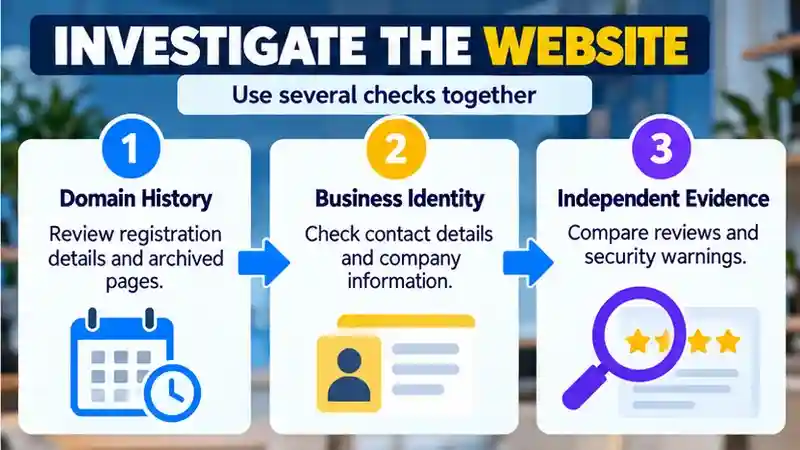
1. Check the domain’s age and registration history
For registration information, use the official ICANN Lookup. Domain age is one clue, not proof that a website is safe or unsafe.
Domain age is one of the strongest legitimacy signals there is. Scam and throwaway sites are almost always young; established businesses almost always aren’t.
- Go to a free WHOIS lookup tool (ICANN Lookup, or whois.com) and search the domain.
- Look at the creation date. A domain registered in the last few months, paired with claims of being an “established platform,” is a red flag.
- Check if the registrant used WHOIS privacy protection. This is common and not automatically suspicious, but combined with other red flags, it adds up.
2. Look at the Wayback Machine
You can review available historical snapshots through the Internet Archive’s Wayback Machine. Missing snapshots do not, by themselves, establish that a website is suspicious.
Head to web.archive.org and paste in the domain. This shows you what the site actually looked like in the past — not what a review article claims.
- If there’s no archive history at all, the site is either brand-new or has actively blocked crawlers.
- If the site’s content, branding, or stated purpose has changed dramatically over time, that’s often a sign of a “recycled” domain — sometimes bought specifically because it has some existing SEO authority, then repurposed for something unrelated (including scams).
Latest FeedBuzzard Com: What the Site Really Is Today and How to Use It

3. Verify the SSL certificate and technical basics
For an additional security check, enter the address into Google Safe Browsing’s Site Status tool. A clean result does not guarantee a site is trustworthy.
- Click the padlock icon in your browser’s address bar and check who the certificate was issued to.
- Run the domain through a free site-safety checker (Google Safe Browsing’s transparency report, VirusTotal, or URLVoid) to see if it’s been flagged for malware or phishing.
- Check whether the site has a real, working contact page — a physical address, a phone number, or a business email on a matching domain (not a generic Gmail address).
4. Search for the company outside its own website
This is the step most people skip, and it’s the most revealing.
- Search
"erikkapost.com" -site:erikkapost.comto filter out the site’s own pages and see what independent sources say. - Check Trustpilot, the Better Business Bureau, and Reddit (search
site:reddit.com erikkapost) for real user complaints or experiences. - Look up the company name (if any is given) in your country’s business registry — in the US, your Secretary of State’s business search; in the UK, Companies House; similar registries exist for most countries.
5. Reverse-check the “proof” it offers
Scam and thin-content sites frequently reuse stolen assets to look credible.
- Reverse image search (Google Images or TinEye) any staff photos, testimonials, or “founder” pictures. Stock photos or images that also appear on unrelated sites are a major red flag.
- Copy a distinctive sentence from the site’s “About” page into a search engine in quotes — if it appears verbatim on several unrelated domains, the content has been copy-pasted or templated, not written by a real team.
VocalNewsMedia Com: Safe to Visit, but Safe to Trust?

6. Test the checkout or signup flow — carefully
If the site sells something, this is where the truth usually comes out. Our guide to evaluating online shopping deals explains how to compare total costs, check seller details, and review return terms before paying.
- Does it ask for payment before showing you any real product detail or terms of service?
- Is there a working refund/returns policy, and does it match consumer protection norms for wherever the company claims to be based?
- Does the checkout redirect to a payment processor you recognize (Stripe, PayPal, a known bank gateway), or an unfamiliar third-party page?
Never enter real card details “just to see what happens.” If you want to test a checkout flow, use a virtual/disposable card number if your bank offers one.
The Site Archetypes You’re Probably Dealing With
Once you’ve run the checks above, an unfamiliar site like this usually turns out to be one of a handful of things:
| Type | Typical signs |
|---|---|
| Legitimate small/new business | Recent domain but real contact info, verifiable business registration, consistent branding, genuine (if few) reviews |
| Affiliate or “review farm” site | Vague content, no working product/service, mostly outbound links to other sites, monetized via ads or referral links |
| Parked/placeholder domain | Little to no real content, generic template, sometimes for sale |
| Dropshipping or low-effort e-commerce | Deep discounts, stock product photos, no verifiable return address, checkout on unfamiliar gateway |
| Phishing or data-harvesting site | Urgency language (“account will be suspended”), requests for sensitive info upfront, mismatched or spoofed branding |
Without verified information, it’s not responsible to place erikkapost.com into one of these buckets for you — but running the six checks above will usually make the answer obvious within minutes.
CloudElder.com Explained: A Simple Way to Decide If It’s Worth Your Time

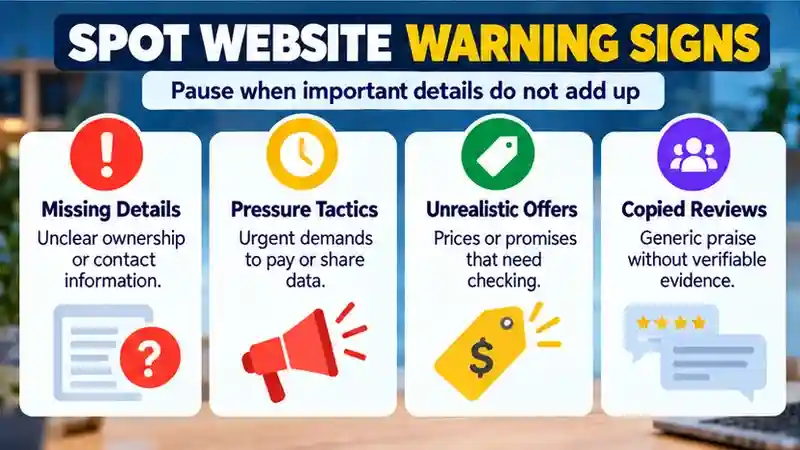
Red Flags Checklist
Run through this list for any site you’re unsure about:
- Domain registered very recently despite claims of being “established” or “trusted since [year]”
- No physical address, phone number, or verifiable company name
- Reviews only exist on the site itself, or on other content-farm-style articles that repeat identical phrasing
- Pressure tactics: countdown timers, “only 2 left,” urgent account warnings
- Prices that are dramatically below market rate
- Payment requested before any real terms, contract, or product detail is shown
- Poor grammar or inconsistent branding across pages
- No HTTPS, or a certificate issued to an unrelated domain
Green Flags Checklist
On the flip side, here’s what real, trustworthy sites usually have:
- A domain history of a year or more, visible in WHOIS and the Wayback Machine
- A real business name that matches a public registry entry
- Independent reviews on third-party platforms (Trustpilot, Google Reviews, BBB) — not just testimonials on their own homepage
- Clear, specific policies: refunds, shipping, data privacy, terms of service
- A support channel that actually responds (test it with a real question before buying)
- Consistent information across the site, its social media, and any app store listings
If You’ve Already Given the Site Information
If you’ve already entered payment details, a password, or personal information on a site you’re now unsure about, don’t wait to “see if something bad happens” — take these steps immediately. If you suspect identity theft, the FTC’s IdentityTheft.gov provides reporting tools and a personalized recovery plan for U.S. users.

- Change the password on that account, and anywhere else you reused it.
- Contact your bank or card issuer if you entered payment details, and ask about a card replacement or a dispute if a charge appears that you didn’t authorize.
- Enable two-factor authentication on your email and any financial accounts, since a leaked email/password pair is often used to try logging into other services.
- Monitor your statements for the next few weeks, and consider a free credit freeze or fraud alert if you shared identity documents.
Frequently Asked Questions
1. Is Erikkapost.com legit or a scam?
Erikkapost.com’s legitimacy has not been confirmed in this guide. Check its business details, domain history, and independent reviews before trusting it. Avoid payments or sharing personal information until you feel confident.
2. What is Erikkapost.com, and what does it offer?
Erikkapost.com is an unfamiliar website whose purpose and services have not been verified in this guide. Check its homepage, About page, and contact details to understand what it offers.
3. How can I check if Erikkapost.com is safe?
Check its domain details through ICANN Lookup, review its history on the Wayback Machine, and look for warnings on Google Safe Browsing. Also search for independent reviews.
4. How can I find out who owns Erikkapost.com?
Look for company details on its About or Contact page. You can also check domain registration records and search official business registries to verify any company information.
5. Why are there so few reliable reviews of Erikkapost.com?
The reason is unclear. The website may have limited public activity, while some online reviews may lack real evidence. Look for detailed user experiences instead of generic claims.
6. What are the warning signs of a suspicious website?
Watch for missing contact details, unclear refund policies, unrealistic discounts, copied reviews, and pressure to pay quickly. Several warning signs together are a reason to be cautious.
7. Is it safe to enter payment details on Erikkapost.com?
Its payment security has not been verified in this guide. Check the website’s identity, payment process, and refund policy first. Avoid entering card details if important information is missing.
8. What should I do if I already shared personal information with a suspicious website?
Change any exposed passwords, enable two-factor authentication, and contact your bank if you shared payment details. Monitor your accounts for unusual activity and take further precautions if needed.
Conclusion
Deciding whether Erikkapost.com is safe or trustworthy takes more than reading online reviews or looking at its website design. An unfamiliar website is not automatically a scam, but it is important to check the facts before trusting it. Start by reviewing its domain history, looking for real business information, and searching for independent user experiences. Tools such as ICANN Lookup, the Wayback Machine, and Google Safe Browsing can help you investigate. If you cannot find enough reliable information, it is better to remain cautious rather than assume the website is safe.
Before creating an account, downloading anything, or making a payment on Erikkapost.com, take a moment to check its contact details, privacy policy, and payment terms. Watch for warning signs such as unclear ownership, suspicious reviews, or requests for sensitive information. The information in this guide does not confirm that Erikkapost.com is legitimate or fraudulent. The safest approach is to verify what you can, avoid unnecessary risks, and wait until you have enough information to make a confident decision.