

Healthcare professionals and medical trainees evaluating OpenEvidence AI need more than a product description: they need to know what the company says it is for, how to check the evidence behind its answers, and what limitations and terms to consider before use. Product details, including access and available features, can change, so confirm them in current official documentation rather than relying on assumptions. This guide offers a practical way to assess those points. Any answer from an AI tool is information to review—not a clinical decision. Patient care still depends on professional judgment and the appropriate clinical sources and processes.
What is OpenEvidence AI?
OpenEvidence AI is a medical information tool associated with OpenEvidence, a company whose product descriptions should be checked on its official website for the latest details. The company presents the service as intended for healthcare professionals seeking clinical information. That description tells you how the company positions the product; it is not, by itself, independent evidence that its answers are accurate, complete, or suitable for a particular clinical task.

Before using it, review current official information to confirm who can access the service, what it currently offers, and any conditions that apply. Features, eligibility, and product descriptions may change, and details should not be inferred from the product name or older coverage. This distinction matters for medical trainees as well as clinicians: a tool designed to provide health-related information is not a substitute for professional judgment, established clinical references, or the processes used to make care decisions.
Try OpenEvidence AI: If you want to learn more about the tool, visit the official OpenEvidence website. You can review the company’s current information there and check whether the service, access requirements, and features fit your needs. Be sure to review the latest terms and privacy information before using it.
How it fits into clinical information searches
A medical search or answer tool may help clinicians and trainees explore a topic, identify questions to investigate, or locate relevant literature. For example, someone might look for background on a condition, compare how different sources discuss a treatment, or find guidance related to a clinical question. These are general examples of information searches, not claims about what OpenEvidence AI currently supports or how well it performs them.

The National Library of Medicine provides a guide to evaluating health information, including source credibility, evidence, and publication dates.
Before relying on a particular function, check OpenEvidence’s current official documentation to confirm what the service offers and who can use it. A generated response can help orient a search, but it may omit important context or point to sources that do not support its claims. Treat the response as a starting point: review the original material and assess whether it applies to the question you are researching. It is not a recommendation for an individual patient or a substitute for clinical judgment.
For additional background, see our guide to how AI systems work. This general explanation does not replace checking medical evidence.
How to assess its evidence and citations
A citation is a lead to check, not proof that an AI-generated answer is complete or correct. For an answer that could affect your understanding of a clinical question, inspect the sources behind it:
- Open the original source rather than relying only on a citation label or summary. Confirm that you are viewing the cited material.
- Check its publication or update date and source type. A guideline, review, trial, or other source serves a different purpose and has different limitations.
- Look for the relevant passage or results. Does the source support the specific claim, or is the answer broader or more certain than the evidence?
- Assess whether the source’s population, setting, and question match yours. Note qualifications and limitations, and look for relevant evidence that points in another direction.
You can independently search for relevant biomedical research through the National Library of Medicine’s PubMed. Always examine the original study and its applicability rather than treating a search result as proof.
A citation may support only part of an answer, and the citations shown may not represent the full range of relevant evidence. For consequential questions, compare original sources with current guidance and other appropriate references. Apply these checks to OpenEvidence AI citations rather than assuming they are comprehensive or dependable.
What to verify before using it
Before relying on OpenEvidence AI, check its current official website, app listing, and applicable terms. Access, features, and eligibility can change, so don’t assume the service is available to every user or in every location.
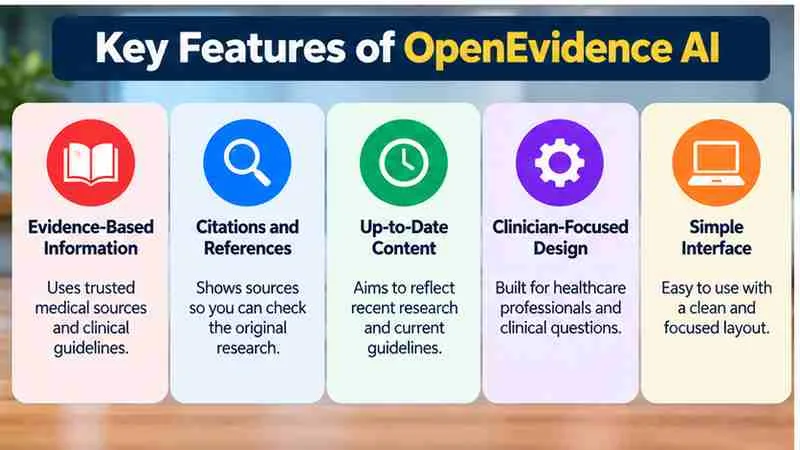
- Access: Confirm how to sign up, whether an account or verification is required, and whether access is available where you work or study.
- Eligibility: Check the current rules for professional status, including whether medical trainees are eligible. Do not assume that a healthcare role automatically qualifies.
- Features: Review official documentation to see which functions are currently offered and whether any limits or conditions apply. Do not infer capabilities from older descriptions.
- Terms: Read the current terms and privacy policy before use. Check for conditions that affect permitted use, data handling, or your responsibilities.
These checks establish what the company currently documents; they do not independently confirm the accuracy or clinical suitability of the tool’s answers.
Limitations and risks to keep in mind
AI-generated medical information can be wrong, incomplete, or out of date. A response may leave out a qualification, overlook relevant evidence, or describe a finding more broadly than its source supports. Fluent, confident wording does not show that an answer is accurate.
These are general cautions about AI-generated information, not claims that OpenEvidence AI has a specific defect. Assess the product based on current documentation and evidence, and verify consequential answers against their original sources.
For a broader discussion of why AI-generated answers require checking, see our article on generative AI assistants and their limitations.
Even a well-supported statement may not apply to an individual patient. Clinical context matters: patient factors, the care setting, and the details of the question can affect how evidence should be interpreted. Recommendations and evidence can also change, so information that was once current may no longer reflect the latest guidance. An answer intended to summarize a topic may not address the circumstances that matter in a particular case.
Use any response as a prompt for further review, not as a stand-alone basis for care. Check relevant sources and guidance, consider whether they fit the clinical question, and follow established review processes and professional judgment.
Privacy and data handling
Clinical questions can involve sensitive details about a person’s health, and even information that seems indirect may help identify someone when combined with other details. Take care before entering patient information into any AI tool.

Before using OpenEvidence AI, review its current official privacy policy and terms to understand what they say about data handling and what uses are permitted. Do not assume that the rules are unchanged or that practices described in older material still apply. Privacy details should be checked in the current documents.
For official information about health data protections, consult the HHS overview of the HIPAA Privacy Rule. Check which requirements apply to your organization and intended use.
Follow your workplace’s policies and applicable professional and legal requirements. Avoid entering identifiable patient information unless doing so is permitted under the relevant terms and rules. If you are unsure, use a de-identified or general question only when your policies allow it, or seek guidance through your organization’s approved process. A tool’s usefulness for finding information does not, by itself, establish that it is appropriate for sensitive data.
A responsible workflow for using an answer
Use OpenEvidence AI, or any medical answer tool, as one step in an information search—not as the final authority. A practical workflow is:
- Use the answer to orient your search. Note claims, terms, and questions worth investigating, but treat them as prompts rather than established conclusions.
- Inspect the original sources. Open relevant citations and check whether they support the specific claims. Confirm their dates, limitations, and relevance to the question.
- Compare the answer with appropriate, current clinical references and guidance. Look for important differences or missing context, and verify consequential claims before they inform practice.
- Apply professional judgment and established review processes. Consider the clinical context and follow the processes used in your setting. Trainees should discuss uncertain or consequential findings through the appropriate supervisory process.
This sequence keeps an AI-generated response in its proper role: a possible aid to locating and reviewing information. It does not replace clinical expertise, professional judgment, or established clinical review, and it should not be treated as a clinical decision.
Questions to ask when comparing alternatives
Compare tools against your clinical information needs and applicable workplace requirements, rather than assuming one option is right for everyone. Ask:
For a general comparison of AI tools and their limitations, see our guide to AI assistants. This is background reading, not a clinical evaluation of OpenEvidence AI.
- Can you trace answers to original sources, and are citations clear enough to check?
- Do the sources’ type, date, and relevance appear suitable for the questions you need to investigate?
- What topics and tasks does the tool cover, according to its current documentation, and what falls outside its stated scope?
- What do the current privacy policy and terms say about data handling and permitted use?
- Is the tool usable in your setting, and can you review its answers within your existing clinical workflow?
- What access, eligibility, or other requirements apply to your role and location?
Check the answers in current official documentation, and consider whether each option fits your needs, professional responsibilities, and established review processes. No feature alone establishes that a tool is suitable for clinical use.
Assess OpenEvidence AI against its current documentation and your actual clinical information needs. For consequential answers, check the original sources and whether they support the claims in the context you are considering. Product details and terms can change, so verify them before use rather than relying on older descriptions or assumptions. An AI-generated response may help orient your research, but it is not an authority or a clinical decision. Responsibility for interpreting evidence, applying it to a patient, and following appropriate review processes remains with the healthcare professional.
Frequently Asked Questions
1. What is OpenEvidence AI?
OpenEvidence AI is a medical information tool intended for healthcare professionals seeking clinical information. Its responses should be checked against original medical research and trusted clinical references.
2. How does OpenEvidence AI work?
OpenEvidence AI is designed to help users explore medical questions through AI-generated responses. Its specific features and source-handling methods should be verified through current official documentation.
3. Who can use OpenEvidence AI?
OpenEvidence AI is intended for healthcare professionals. Medical trainees may also be interested, but eligibility, verification requirements, and access conditions should be confirmed through the official website.
4. Is OpenEvidence AI free to use?
Current pricing and access requirements should be checked on the official OpenEvidence website. Availability, eligibility conditions, and usage restrictions may change over time.
5. Can OpenEvidence AI provide accurate medical information?
OpenEvidence AI may provide useful medical information, but AI-generated answers can contain errors or missing context. Verify important claims against original studies, current guidelines, and reliable clinical references.
6. Is OpenEvidence AI safe for patient information?
Review the platform’s current privacy policy and your organization’s requirements before entering clinical information. Avoid sharing identifiable patient details unless applicable rules and service terms explicitly permit it.
7. Can OpenEvidence AI replace medical professionals?
No. OpenEvidence AI should not replace qualified healthcare professionals, clinical judgment, or established care processes. Its responses are informational and require appropriate evidence verification.
8. Is OpenEvidence AI worth using for medical research?
OpenEvidence AI may be useful for exploring clinical questions and locating information to investigate. Evaluate its citations, accuracy, privacy terms, and suitability for your professional workflow before relying on it.
Conclusion
OpenEvidence AI is a medical information tool that healthcare professionals and medical trainees may consider when researching clinical questions and exploring medical literature. Its potential usefulness depends on the quality, relevance, and verifiability of the information it provides. However, AI-generated medical responses should never be treated as automatically accurate or complete, even when they include citations. Users should examine original studies, check publication dates, and determine whether the cited evidence supports the specific claims being made. Comparing important findings with current clinical guidelines and other trusted references is essential, particularly when the information could influence patient care or professional decisions.
Before using OpenEvidence AI, review its current features, eligibility requirements, privacy policy, and terms of use through the official website. Healthcare professionals should also follow applicable workplace policies and avoid sharing identifiable patient information unless explicitly permitted. A responsible approach involves starting with general clinical questions, checking the supporting research, and evaluating whether the tool fits established information-review processes. Although AI may assist with exploring medical topics, it cannot replace professional expertise, clinical supervision, or individualized patient assessment. Ultimately, OpenEvidence AI should be considered an additional information resource whose outputs require careful verification and appropriate professional oversight.