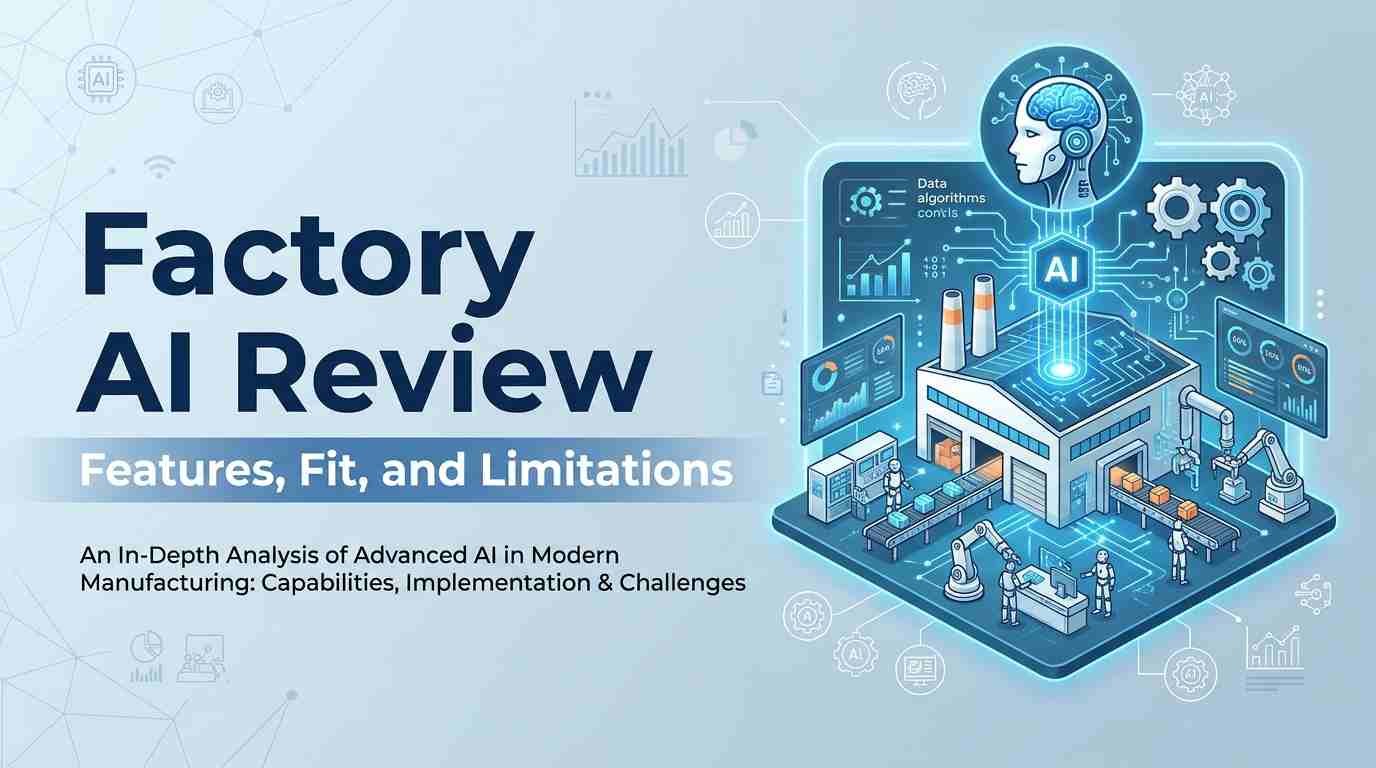
This Factory AI review explores whether the platform could be a useful addition to your software development workflow. From understanding its potential coding capabilities to evaluating compatibility, security, and overall value, there are several factors worth considering before adopting it. The goal is to help developers and teams make an informed decision based on verified product information and practical needs.
This guide explains Factory AI in plain language and looks at its potential uses, who may find it a fit, and what to examine before adopting it, including pricing, access, and data handling. Product features and terms can change, so check current details directly. Where capabilities have not been independently tested, they should be treated as product information—not proof of performance in your workflow.
What is Factory AI?
I can’t verify Factory AI’s current product description or terminology from the information available for this article. That means I can’t reliably say which development tasks it supports, how it fits into a software team’s tools, or whether it currently describes its system as an “AI agent.” Check Factory’s own product materials for those details before relying on them.
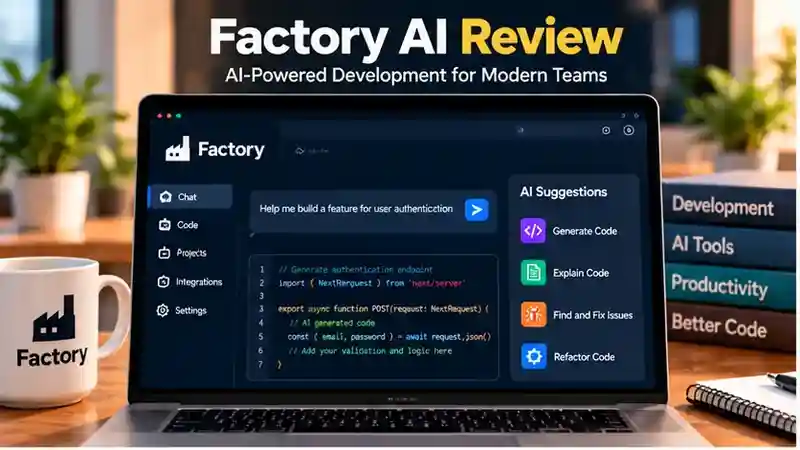
In general, an AI agent is software that can take steps toward a task, rather than only responding with a single suggestion. In software development, that might mean helping with work such as changing code or investigating a problem, depending on the product’s actual capabilities. The term does not mean the software works reliably or without oversight: developers still need to review its actions and results.
To understand the broader technology behind AI agents, read our guide to Open Source AI Agents, which explains how these systems work and what to consider before using them.
For Factory AI, treat specific capability claims as unverified until you confirm them in current documentation or test them in your own environment.
Explore Factory AI on Its Official Website
If you want to learn more about Factory AI and its current capabilities, you can visit the official Factory AI website. There, you can explore the platform’s product information, available features, documentation, and access options. Before using it for software development, review its current pricing, supported integrations, security practices, and data-handling policies to determine whether it fits your workflow.
How it works
I can’t verify Factory AI’s current workflow from the information available for this article, and I haven’t independently tested the product. I therefore can’t confirm how users submit tasks, what steps the system takes, or how it returns proposed changes. Check Factory’s current documentation for those details before assuming it works like another coding tool.
As a general way to assess a development AI, look for a workflow that lets you describe a bounded task, understand what the tool proposes or changes, and review the result before it becomes part of your codebase. The exact steps and controls depend on the product, so confirm what Factory AI supports rather than treating this as a description of its interface.
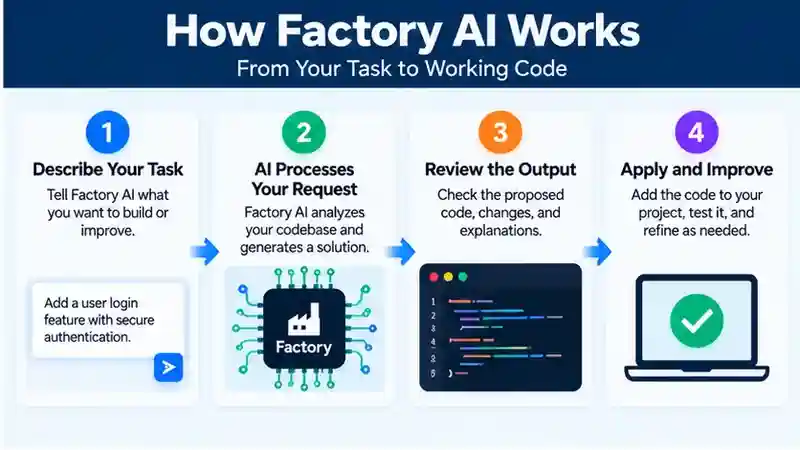
Whatever the workflow, keep normal development review in place. Inspect proposed changes, check that they meet the task’s requirements, and run the tests or other validation your project uses. An AI tool may help with parts of development, but its output should not be treated as verified simply because it was generated. Consider how much review a task needs before deciding whether the tool saves time in your process.
For teams using GitHub, the official guide to reviewing proposed changes explains how developers can inspect code differences, leave feedback, and approve or request changes before merging. These review practices are also relevant when evaluating AI-generated code.
What can it help you do?
I can’t verify Factory AI’s current feature list from the information available for this article, and I haven’t tested the product. So I can’t confirm which development tasks it supports or describe any task as a demonstrated capability. Check Factory’s current product materials for the workflows it advertises, and treat those descriptions as product claims rather than independent evidence of results.
When reviewing those claims, look for specifics: what kinds of code or repository tasks the tool handles, which development tools it works with, and what steps a developer must take to approve or review its work. A feature’s availability may depend on your setup, permissions, or plan, so verify those details for your own environment.
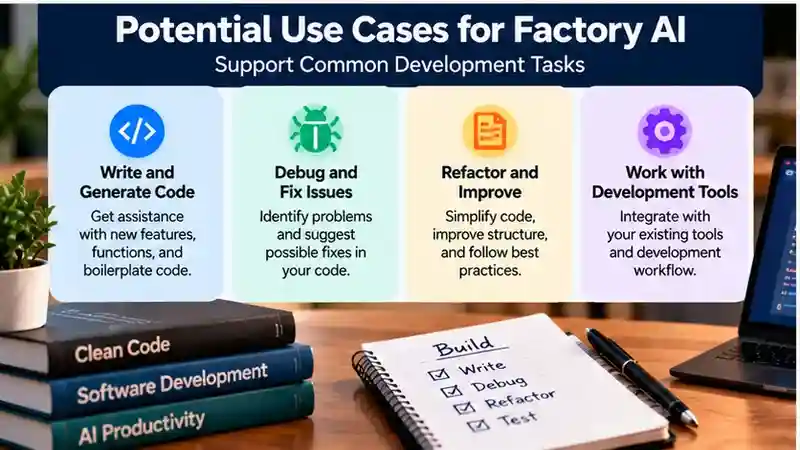
If Factory AI advertises help with a task relevant to your team, try it on a small, non-critical example before relying on it for important work. Check the output against the task, inspect any proposed changes, and use your usual tests and review process. Until you do, treat potential uses as possibilities—not a guarantee that the tool will complete the work correctly or reduce the effort required.
This Factory AI review focuses on evaluating supported coding tasks through documentation and practical testing rather than assuming that every advertised feature will work equally well for every team.
Who might find it useful?
Factory AI may be worth evaluating for developers or software teams looking for help with recurring development work, or for tasks that take time away from higher-priority work. It could also interest teams exploring whether an AI tool fits into an existing development process. Those are possible reasons to investigate it, not confirmed strengths: I can’t verify Factory AI’s current supported tasks or integrations, and I haven’t tested it.
Fit depends on what the product currently supports and how your team works. Before assuming it will suit your workflow, check whether it supports the tools, repositories, permissions, and review steps your team relies on. Individual developers and small teams may also want to consider how much time they can devote to checking its output. If you can’t verify compatibility or safely review proposed work, it may be better to wait or limit any evaluation to a low-risk task.
For readers exploring a different approach to AI automation, our guide to Building a Useful AI Agent Without Writing Code explains how no-code agent builders work and what limitations to consider.
Where it may fall short
I haven’t independently tested Factory AI, and the available information doesn’t confirm product-specific limitations. Before relying on it, check its current documentation and try it in a controlled setting. In general, AI development tools can produce code or explanations that are incorrect, incomplete, or mismatched to a task. That is a general caution, not a tested finding about Factory AI. Review any proposed work against the requirements, and use your normal tests and code-review process before accepting changes.
Also consider the effort involved in checking results. A tool may be less useful if reviewing and correcting its output takes as long as doing the task yourself, or if your team lacks a clear approval process. Measure the time spent on the whole task, including setup and review, rather than judging the tool only by how quickly it produces an answer.
Workflow fit can depend on which integrations Factory AI currently supports and what access it needs. Confirm compatibility with your development tools and repositories, and check whether the required permissions are appropriate for your organization. Don’t grant access to code or systems until you understand what the tool can access and your team’s rules allow it.
Pricing, access, and data handling
I can’t verify Factory AI’s current pricing, access requirements, or plan terms from the information available for this article. Check Factory’s official materials for current costs, eligibility, and any limits that apply to the features you want to use. Don’t assume a free option, trial, or particular plan is available without confirming it directly.
For this Factory AI review, pricing and access should be assessed using the latest official information, especially if your team needs specific integrations, permissions, or usage limits.
For a broader understanding of AI application security, review the OWASP Top 10 for LLM Applications. It covers important risks such as sensitive information disclosure, prompt injection, and excessive permissions. These are general AI security considerations, not verified vulnerabilities in Factory AI.
Before connecting a repository or sharing code, review Factory’s current privacy and security information. Look for what data the service collects, how code and other submitted information are used, how long they are retained, and whether they may be used to improve its systems. Check what controls are available for access, permissions, and data management; I can’t confirm which controls Factory AI currently offers.
If you’re evaluating it for a team, involve the people responsible for security, privacy, and procurement. Confirm that the service’s terms, data practices, and administrative options meet your organization’s requirements before granting access. These details can change, so verify them directly before making a decision.
Read Also: Self-Hosted AI: What You Need to Get Started
How to evaluate Factory AI
Since Factory AI’s current capabilities and terms haven’t been independently verified here, treat a trial as a way to answer specific questions—not as proof that the tool will suit every task. Keep the test small and follow your organization’s security rules.
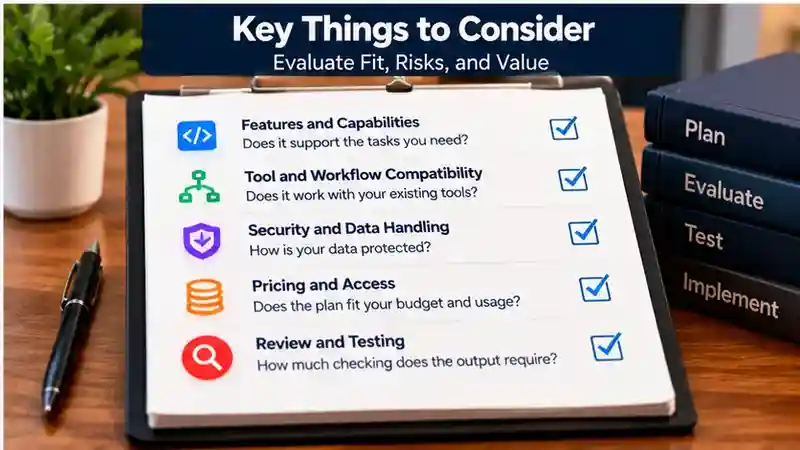
- Choose a few representative, bounded tasks your team often handles, such as a small code change or straightforward investigation, if Factory AI’s current documentation says it supports them. Use non-sensitive code or an approved test environment. Don’t connect repositories or share data unless your organization permits it.
- Set a baseline by noting how your team completes the same tasks now, including time spent doing the work, testing it, and reviewing it. Compare that with the full effort using Factory AI—not just how quickly it produces an output.
- Check quality and review effort. Compare results with task requirements, inspect proposed changes, and run relevant tests. Record errors, missing work, and corrections. Consider whether the output is useful and whether reviewing it takes less time than the current process.
- Check workflow and access. Verify compatibility with your tools and repositories, confirm the permissions the trial requires, and review available access controls and data-handling terms with the appropriate people in your organization.
- Calculate the full cost. Confirm current pricing and any limits relevant to your intended use. Include setup, administration, review time, and other expected costs in the comparison.
Expand the trial only if the results are useful, review remains manageable, and security, compatibility, and cost meet your requirements.
Is Factory AI worth considering?
Factory AI may be worth evaluating if its current capabilities match work your team needs help with and it fits your development workflow. But its advertised features are not evidence that it will perform well on your code: I haven’t independently tested the product, and I can’t verify its current features, integrations, pricing, or terms from the information available here.
Before deciding, check Factory’s current product and data-handling details, confirm compatibility and required permissions, and compare the full cost with any time saved. Include the effort needed to review and correct its output, not just the time it takes to generate it. A small, approved trial on representative, low-risk tasks can help you judge whether the results are useful in your environment. If you can’t verify its fit or meet your organization’s data requirements, hold off on broader use. Product details can change, so confirm them directly before committing.
The key takeaway from this Factory AI review is to verify the platform’s current capabilities and measure its results in your own development environment before making a broader commitment.
Frequently Asked Questions
1. What is Factory AI?
Factory AI is a software-development-focused AI product. Developers and teams can review its official documentation to understand its current coding capabilities, supported workflows, and available integrations.
2. How does Factory AI work?
Factory AI’s specific workflow should be confirmed through its current documentation. When evaluating it, check how development tasks are submitted, how results are produced, and how developers review proposed changes.
3. Who should consider using Factory AI?
Factory AI may interest software developers and engineering teams exploring AI-assisted development. Its suitability depends on supported tasks, existing tools, security requirements, and review processes.
4. What coding tasks can Factory AI perform?
The product’s current supported tasks have not been independently verified in this guide. Check Factory AI’s official feature documentation and test relevant capabilities before relying on them.
5. Is Factory AI free to use?
Factory AI’s current pricing and free-access options have not been verified in this article. Visit its official website to confirm available plans, access requirements, and usage limits.
6. Is Factory AI safe for private code repositories?
Review Factory AI’s current security documentation, repository permissions, and data-handling policies before connecting private code. Follow your organization’s security requirements and limit unnecessary access.
7. What are the limitations of Factory AI?
Its product-specific limitations have not been independently tested here. AI coding tools generally may produce incorrect changes, require extensive review, or encounter integration and compatibility restrictions.
8. Is Factory AI worth using for software development?
Factory AI may be worth evaluating if its verified capabilities match your development needs. Test it on a small, approved task and compare results, review effort, costs, and security requirements.
Conclusion
Factory AI may be worth considering for software developers and engineering teams exploring AI-assisted development workflows. However, its practical value depends on the tasks it currently supports, compatibility with existing development tools, and the quality of its results. Before adopting Factory AI, review its official documentation to confirm available features, integrations, access requirements, and limitations. Product descriptions can help identify potential uses, but they do not establish reliable performance in your own environment. Developers should continue reviewing proposed code changes, running appropriate tests, and checking whether generated results meet project requirements. A useful development tool should support established engineering practices rather than replace necessary verification and professional judgment.
When evaluating Factory AI, consider pricing, security, repository permissions, data-handling practices, and the time required for setup and ongoing review. Teams working with confidential code should confirm that the platform’s current policies and controls meet their organizational requirements before granting access. Begin with a small, low-risk development task in an approved environment and compare the complete workflow against your existing process. Measure output quality, correction time, testing effort, and overall costs rather than focusing only on generation speed. If Factory AI provides useful results while meeting your technical and security requirements, broader adoption may be worth exploring. Otherwise, maintaining your current workflow or comparing alternatives may be more appropriate.