

AI systems can show up in familiar places: suggesting a song, sorting an email, transcribing speech, or helping draft a message. The feature may seem simple, but it can depend on several parts working together—and its results may need a person to check them.
Understanding that distinction makes it easier to decide when a tool is useful and when to be cautious. This guide explains what counts as an AI system, how information moves through one to produce an output, and where these systems can help or fall short. It also offers practical questions to consider before relying on a system, including what information you share, how you can verify its results, and when human judgment matters.

What counts as an AI system?
An AI system is the broader setup that uses artificial intelligence to do a task. Depending on how it is built, that setup may include a model, the data provided to it, software that connects it to other tools, an interface people use, and steps for human review. Not every system has the same components.
For a practical example of a model used within a larger application, see our ChatGPT for Writing guide, which explains how people provide instructions and review generated responses.
A model is one part of the picture: it performs a particular task, such as identifying patterns in text or estimating which category an item belongs in. The system puts that model to use. For example, a model might suggest a reply to a message. The wider system could take in the message, show the suggestion in an email interface, and let the user edit, accept, or ignore it.
Using AI does not mean handing a task over to a machine completely. A person might choose what information to submit, review the result, and decide what happens next. In other cases, a system may carry out more steps automatically. The important distinction is that the model’s task is only one piece; the system also includes the surrounding technology and, often, the people and processes involved.
How an AI system produces an output
Most AI systems start with an input: something a person provides or an event the system detects. That might be a question typed into a chat tool, a photo submitted for sorting, or a voice command. The system may also use other information, such as settings or details from the service it is part of.

For a formal definition of an AI system and its outputs, consult the OECD AI Principles.
Next, software passes relevant information to an AI model or another processing component. The model applies patterns it has learned or rules it has been given to perform a task, such as generating text, identifying an image, or estimating a likely outcome. Other parts of the system may then format the result, apply additional checks, or decide what to show. The steps differ by system; there is no single pipeline that describes them all.
The system presents an output, which could be a label, recommendation, prediction, transcription, or generated response. A person may review it, edit it, act on it, or reject it. In some settings, the system may trigger a further step with less direct human involvement, so it matters to understand how much control a person retains.
An output is shaped by the system’s design and the information available to it. It is not proof that the system understands the situation as a person would, or that its answer is true. Missing or unclear input can affect the result, and a polished response can still be wrong. When accuracy matters, check the output against dependable information before relying on it.
Common kinds of AI systems
AI systems can be grouped by the tasks they perform. The categories can overlap, and a single service may use more than one kind of system.

To compare conversational systems with other tools, read our ChatGPT alternatives guide and consider how different assistants fit particular tasks.
- Classification and prediction: These systems sort information into categories or estimate what may happen. For example, one might flag a message as possibly unwanted or estimate which category an item belongs in. A prediction is an estimate, not a guarantee.
- Recommendations: These systems suggest content, products, or actions based on information available to them. A service might suggest songs or videos a person could explore. Those suggestions reflect the system’s design and inputs; they are not necessarily a complete or neutral view of the options.
- Speech and image recognition: These systems process audio or visual information. A speech tool might turn spoken words into text, while an image tool might help sort photos by their contents. Results can depend on the quality and clarity of the input.
- Generation: These systems produce material such as text, images, or summaries in response to instructions or other input. The result may be a useful starting point, but it can still include mistakes or miss important context.
These labels describe tasks, not the entire system. A feature that recommends content, for example, may also collect input, display suggestions in an interface, and let a person respond. To assess a tool, consider how its parts work together—not just the category attached to its AI feature.
Where people encounter them
AI systems can be part of everyday digital services, such as tools that sort messages, suggest content, or help transcribe speech. In workplace software, they may support tasks like searching documents, summarizing information, or drafting text. Customer support tools may use AI to help interpret a question or suggest a response, while creative software may offer features for generating or editing written, visual, or audio material.
These examples describe possible uses, not features of any particular service. A tool’s visible function may rely on several components working together: an AI model, the information it receives, software that connects it to other services, and an interface where someone reviews or acts on the result. Some systems also involve people behind the scenes, such as staff who check outputs or handle requests that need more attention.
AI use is not always obvious. A service may present a recommendation or search result without explaining how it was produced, and a familiar feature may combine AI with other software and human decisions. If it matters how a tool handles information or makes suggestions, check its available explanations, settings, and terms rather than assuming its inner workings from what you see on screen.
What AI systems do well—and where they fall short
Depending on the task and how they are designed, AI systems can help with work that involves repeating the same steps, such as sorting information or turning speech into text. They can also spot patterns across the information they receive and produce a first draft of text or other material. These capabilities may save time or give people a starting point, but they do not make every output useful or accurate.
Systems can make mistakes, especially when an input is unclear, incomplete, or different from what they handle well. They may also lack context that a person would consider important. Performance can vary across tasks and situations, so success with one kind of input does not guarantee the same result with another. Generated responses can sound certain even when they contain an error or leave out a key detail.
Think of an AI output as something to assess, not accept automatically. For a low-stakes task, a quick review may be enough; for decisions where an error could matter, check important claims against dependable information and use your own judgment. Consider whether the system has the context it needs, and whether a person can review its result before action is taken. The right level of checking depends on what the system is being used for and what could happen if its output is wrong.
Privacy, security, and fairness considerations
Before using an AI system, consider what information you will provide and what might happen to its outputs. Practices can vary by service, so check the relevant terms, privacy information, and available controls rather than assuming how a tool handles information.
The NIST AI Risk Management Framework FAQs explain key trustworthiness considerations, including privacy, security, reliability, and fairness.
- What information does the system receive? Does the task require personal, sensitive, or confidential details, or could you leave them out or remove identifying information?
- How may information be handled? What do the service’s terms say about submitted information and outputs, and are there settings that affect this?
- Who can access the output? Could people in your organization, other users, or anyone you share it with see the result? Check the service’s access and sharing controls.
- Could the system work unevenly for different people? Might its results be less useful for some inputs, languages, or circumstances? If a decision matters, consider who could be affected and whether a person can review the result.
These questions matter especially when information is sensitive or an output could affect someone’s opportunities, access, or treatment. If the terms or controls do not answer a question you have, treat that uncertainty as part of your decision. You might share less information, avoid the tool for that task, or choose another way to complete it. Privacy, security, and fairness are part of usefulness: a system that does not fit your needs or safeguards may not be the right one to rely on.
How to evaluate an AI system before relying on it
A short personal test can help you decide whether a tool fits a particular task, but it cannot establish that the system is reliable in every situation. Work through these checks in order:
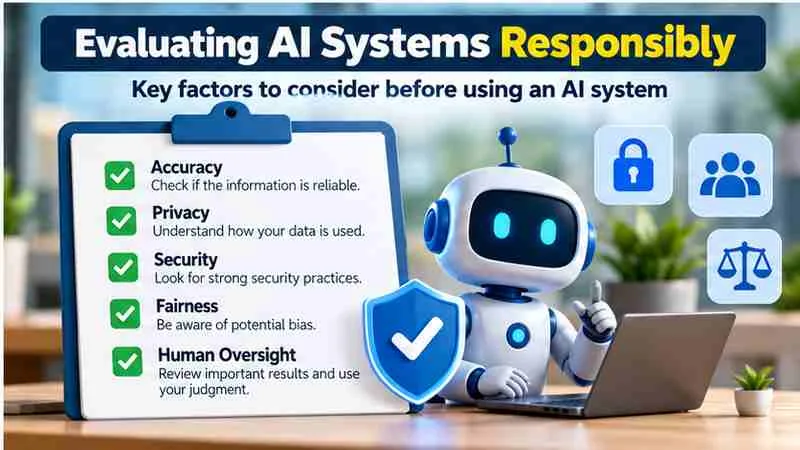
- Define the task. Be specific about what you want the system to do and what a useful result would look like. Consider what could happen if the result is wrong.
- Try representative inputs. Test examples that reflect the information and situations you expect to encounter, including unclear or incomplete inputs when relevant. A few successful results are an initial indication, not proof of dependable performance.
- Check the outputs. Compare results with dependable information or your own knowledge. Look for errors, missing context, and answers that sound certain but are difficult to verify.
- Look for limitations and human oversight. Check what the service says about where it may perform poorly. Find out whether a person can review or correct results before they are used, especially when the task has meaningful consequences.
- Review privacy and security controls. Check what information the system receives, the service’s terms, available settings, and who may be able to access or share outputs. Avoid submitting information that is not needed for the task.
This is informal personal testing: a practical way to judge whether a tool seems suitable for your use. It is not a formal evaluation, which may require a defined test process, broader inputs, and appropriate review for the intended setting. If you cannot verify an important result, do not treat a quick trial as a reason to rely on it. Match the level of scrutiny to the task and the possible consequences of an error.
Learn More About Responsible AI Systems
If you want to explore how AI systems can be evaluated and managed responsibly, you can visit the NIST AI Risk Management Framework. This official resource provides guidance on understanding and managing risks associated with AI systems, including reliability, safety, privacy, and fairness. It can help readers explore important considerations when assessing AI technologies, although it is not a substitute for testing a specific tool.
Using AI systems responsibly in daily life
Before using an AI system, share only the information it needs for the task. Leave out personal or confidential details when they are not necessary, and check the service’s terms and settings if you are unsure how information may be handled.
Treat generated text, images, and recommendations as starting points rather than finished work. Review the result, make sure it fits your needs, and check important claims against dependable information. A fluent answer can still be inaccurate or missing context.
Keep human judgment in the process when an output could affect someone’s health, finances, work, access to services, or other important matters. Consider whether a person can review the result before it is used, and do not rely on an AI output you cannot verify for a consequential decision.
The safeguards you need depend on the task and what could happen if the system is wrong. A low-stakes suggestion may need only a quick check; sensitive information or high-impact decisions call for more care. Use the system only when its capabilities, limitations, and privacy controls suit the job.
A clearer way to think about AI systems
An AI system is more than the model behind a feature. Its inputs, software, interface, privacy controls, and human review can all affect whether it is useful and appropriate for a task. So look beyond the AI label: identify what you need the tool to do, how you can check its output, and what may happen to the information you provide.
Choose a system that fits a specific need, and account for its limits and the consequences of mistakes. A tool that works well for a draft may not be suitable for a decision that needs careful verification. As products and their practices change, revisit whether the system still meets your needs. When in doubt, use it as support—not a substitute for informed human judgment.
Frequently Asked Questions
1. What is an AI system?
An AI system combines artificial intelligence with supporting software, data, and processes to perform tasks. It may generate content, recognize patterns, make predictions, or provide recommendations, depending on its design.
2. How do AI systems work?
AI systems receive inputs, process information using models or other components, and produce outputs such as predictions, recommendations, or generated content. Their exact processes depend on the technology and intended task.
3. Where are AI systems used in everyday life?
AI systems appear in email filtering, music recommendations, speech recognition, customer support, document summarization, and writing tools. Their usefulness depends on the task and the quality of their outputs.
4. What are the main benefits of AI systems?
AI systems can help organize information, automate certain repetitive tasks, identify patterns, and support content creation. However, their effectiveness varies across applications, and human review may still be necessary.
5. What are the main limitations of AI systems?
AI systems may produce inaccurate results, misunderstand inputs, overlook context, or perform inconsistently. Their outputs should be checked carefully, especially when mistakes could have significant consequences.
6. How can I evaluate an AI system before using it?
Define your task, test the system with realistic examples, and compare its outputs with reliable information. Also review its limitations, privacy policies, security settings, and available human oversight.
7. Are AI systems safe for personal information?
Safety depends on the system’s design, privacy practices, and security controls. Review how your information may be collected, stored, and shared before submitting personal or confidential material.
8. Can AI systems replace human decision-making?
AI systems can support decisions by organizing information and providing suggestions, but they should not automatically replace human judgment. Important decisions require reliable evidence, appropriate oversight, and careful evaluation.
Conclusion
AI systems are increasingly used in everyday digital activities, from filtering emails and recommending content to recognizing speech, organizing information, and generating written material. Understanding how AI systems work involves looking beyond the underlying model to consider input data, supporting software, interfaces, and human involvement. These components influence how information is processed and whether the resulting output is useful for a particular task. Although AI systems can help automate certain activities and support productivity, their performance depends on their design, available information, and intended purpose. Choosing an appropriate system requires understanding its capabilities and testing whether it meets your practical needs.
Responsible use of AI systems also requires attention to accuracy, privacy, security, fairness, and human oversight. AI-generated outputs can contain mistakes, omit important details, or present uncertain information confidently. Before relying on a system, review its documentation, test it with representative examples, and verify important results against dependable sources. Avoid sharing unnecessary sensitive information, and check the provider’s current privacy policies and security controls. For decisions involving health, finances, employment, or other significant consequences, maintain appropriate human review and seek qualified guidance when necessary. Ultimately, AI systems are most valuable when their capabilities support meaningful tasks while users remain informed about their limitations and potential risks.